from kerchunk.netCDF3 import NetCDF3ToZarr
from kerchunk.combine import MultiZarrToZarr, auto_dask, JustLoad
from kerchunk.utils import subchunk, inline_array
from fsspec.implementations.reference import LazyReferenceMapper
import fsspec
import xarray as xr
import datetime as dt
import copy
import kerchunk
import base64
import struct
import numpy as npGenerate multifile references for HYCOM using kerchunk


HYCOM data on AWS Open Data are stored in 63,341 NetCDF 64-bit offset files. The data in these files are stored as short integers with scale_factor and add_offset, but because these are not NetCDF4 files, there is no compression and no chunking. Each file contains one time step of data.
We generate references for each file, and use kerchunk.utils.subchunk to create virtual chunks so that each vertical layer is treated as a chunk. For this uncompressed data, the byte-ranges are the same for each file, so we only need to create references for one file and then clone that for all the files, changing only the URL and the time value.
Overall workflow
This notebook demonstrates a kerchunk workflow for converting many NetCDF files into a virtual Zarr dataset without copying the data. The goal is to make large collections of model output (like HYCOM) behave like a single cloud‑optimized dataset.
Key idea: Kerchunk builds references, not data
- The process reads NetCDF metadata.
- It records where each variable and chunk lives inside the file.
- The result is a mapping (JSON or Parquet) kerchunk → byte range in original NetCDF file
This means:
- No data duplication
- Very fast dataset assembly
- Works well with cloud storage
It enables:
- cloud‑native access
- fast subsetting
- scalable analysis
The mental model:
NetCDF files
      ↓
kerchunk reference generation
      ↓
combined reference dataset
      ↓
virtual Zarr dataset
      ↓
xarray.open_dataset()
Step 1. Build a template reference dictionary used across files
The files need to be structurally identical. For example:
temperature(time, depth, lat, lon)Each file needs to contain:
- the same variables
- the same grid
- the same dimensions
- a different time slice
The template dictionary defines the dataset schema. We will update the data file urls (to the netcdfs) in that dictionary.
Step 2. Create a list of dictionaries
From the template, update the data file urls (to the netcdfs) in that dictionary to create a dictionary for each file.
Step 3. Write the data dictionary to parquet
Instead of saving one large JSON reference file (which is an option), this workflow stores references in Parquet.
- faster reads
- better scalability
- efficient metadata access
- works well with distributed systems
Do all NetCDF files need to have the same structure to create a virtual Zarr dataset?
In most cases, yes — the NetCDF files used to build a virtual Zarr dataset (for example with kerchunk, VirtualiZarr, or MultiZarrToZarr) must have a consistent structure. The most important requirements are:
1) Variables must be consistent The same variables should exist in each file (e.g., temperature, salinity). If a variable appears in some files but not others, the virtual dataset may fail to build or behave unpredictably.
2) Dimensions must be compatible Dimensions like lat, lon, and depth usually need to be identical across files. The dimension along which files are combined — typically time — can differ in length, because that is the axis being concatenated.
3) Coordinate systems must match
- Same latitude and longitude values
- Same vertical levels
- Same projection or reference system
4) Chunking and compression can differ These are storage details and usually do not need to match. Kerchunk reads the metadata and builds references regardless of how the data are chunked internally.
Let’s get started!
%%time
fs = fsspec.filesystem('s3', anon=True)
flist = fs.glob('hycom-gofs-3pt1-reanalysis/*/*.nc')
CPU times: user 6.65 s, sys: 232 ms, total: 6.88 s
Wall time: 10.3 slen(flist), flist[0](63341,
'hycom-gofs-3pt1-reanalysis/1994/hycom_GLBv0.08_530_1994010112_t000.nc')Generate the dictionary for the file structure
We only need to do for one file since the byte layout is the same.
%%time
import json
d0 = NetCDF3ToZarr("s3://" + flist[0], storage_options={"anon": True},
                  inline_threshold=400, version=2).translate()
# Subchunk the 4D data vars
for v in ['salinity', 'water_temp', 'water_u', 'water_v']:
    d0 = subchunk(store=d0, variable=v, factor=40)
CPU times: user 360 ms, sys: 90.9 ms, total: 451 ms
Wall time: 1.97 sTest the template dictionary from the first file in the dataset
# Storage options (for accessing the NetCDF files from AWS)
so = dict(anon=True, skip_instance_cache=True)
ds = xr.open_dataset(d0, engine='kerchunk', chunks={}, drop_variables='tau',
                     backend_kwargs=dict(storage_options=dict(
remote_protocol='s3', lazy=False, remote_options=so)))ds<xarray.Dataset> Size: 19GB
Dimensions: (time: 1, depth: 40, lat: 3251, lon: 4500)
Coordinates:
* time (time) datetime64[ns] 8B 1994-01-01T12:00:00
* depth (depth) float64 320B 0.0 2.0 4.0 ... 3e+03 4e+03 5e+03
* lat (lat) float64 26kB -80.0 -79.96 -79.92 ... 89.96 90.0
* lon (lon) float64 36kB -180.0 -179.9 -179.8 ... 179.8 179.9
Data variables:
water_u (time, depth, lat, lon) float64 5GB dask.array<chunksize=(1, 1, 3251, 4500), meta=np.ndarray>
water_u_bottom (time, lat, lon) float64 117MB dask.array<chunksize=(1, 3251, 4500), meta=np.ndarray>
water_v (time, depth, lat, lon) float64 5GB dask.array<chunksize=(1, 1, 3251, 4500), meta=np.ndarray>
water_v_bottom (time, lat, lon) float64 117MB dask.array<chunksize=(1, 3251, 4500), meta=np.ndarray>
water_temp (time, depth, lat, lon) float64 5GB dask.array<chunksize=(1, 1, 3251, 4500), meta=np.ndarray>
water_temp_bottom (time, lat, lon) float64 117MB dask.array<chunksize=(1, 3251, 4500), meta=np.ndarray>
salinity (time, depth, lat, lon) float64 5GB dask.array<chunksize=(1, 1, 3251, 4500), meta=np.ndarray>
salinity_bottom (time, lat, lon) float64 117MB dask.array<chunksize=(1, 3251, 4500), meta=np.ndarray>
surf_el (time, lat, lon) float64 117MB dask.array<chunksize=(1, 3251, 4500), meta=np.ndarray>
Attributes:
classification_level: UNCLASSIFIED
distribution_statement: Approved for public release. Distribution unli...
downgrade_date: not applicable
classification_authority: not applicable
institution: Naval Oceanographic Office
source: HYCOM archive file
history: archv2ncdf3z
field_type: instantaneous
Conventions: CF-1.6 NAVO_netcdf_v1.1Create functions to write dicts for all files from the template
We could repeat the code above, but 3 seconds x 63341 files is over 40 hours.
We need to define some functions to replace all the URLs in the reference dict d0.
d0["salinity/0.2.0.0"]['s3://hycom-gofs-3pt1-reanalysis/1994/hycom_GLBv0.08_530_1994010112_t000.nc',
3657441984,
29259000]def float_to_base64(number):
# Pack the float into bytes
packed = struct.pack('>d', number)
# Encode the bytes to base64
encoded = base64.b64encode(packed)
# Convert bytes to string and return
return encoded.decode('utf-8')
# Example usage
float_num = 122748.
encoded_str = float_to_base64(float_num)
print(f"Original number: {float_num}")
print(f"Base64 encoded: {encoded_str}")Original number: 122748.0
Base64 encoded: QP33wAAAAAA=def replace_first_item(d, target_string, replacement_string):
for key, value in d.items():
if isinstance(value, dict):
# Recursively process nested dictionaries
replace_first_item(value, target_string, replacement_string)
elif isinstance(value, list) and value and isinstance(value[0], str):
# Check if the value is a non-empty list and the first item is a string
if value[0] == target_string:
value[0] = replacement_string
return d
# Function to generate the time from the filename
def name2date(f):
year = f[51:55]
month = f[55:57]
day = f[57:59]
# hour = f[59:61] #always 12 for this dataset
tau = f[64:66]
return dt.datetime(int(year), int(month), int(day), int(tau))Loop through all the files, generating the references for each file by replacing the URL and date in the reference dict template. I had to patch the dict.
%%time
# I had to patch Rich's function
import json
import struct
import base64

dlist = []
time0 = dt.datetime(2000,1,1,0)

for i, v in enumerate(flist):
    dmod = copy.deepcopy(d0)

    time1 = name2date(v) + dt.timedelta(hours=12)
    time_val = (time1 - time0).total_seconds()/3600

    encoded_str = float_to_base64(time_val)

    # --- ADD THESE 3 LINES to PATCH ---
    z = json.loads(dmod["time/.zarray"])
    z["compressor"] = None
    dmod["time/.zarray"] = json.dumps(z)
    # -------------------------

    dmod["time/0"] = f"base64:{encoded_str}"

    dmod = replace_first_item(
        dmod,
        f"s3://{flist[0]}",
        f"s3://{v}"
    )

    dlist.append(dmod)
CPU times: user 32.8 s, sys: 750 ms, total: 33.6 s
Wall time: 33.6 slen(dlist)63341# I was getting errors so run this
import nest_asyncio
nest_asyncio.apply()%%script false
# Rich's code but I am getting errors with this approach
combined_parquet = 'hycom.parq'
out = LazyReferenceMapper.create(combined_parquet, fs=None, record_size=100000)
_ = MultiZarrToZarr(
dlist,
remote_protocol="s3",
concat_dims="time",
identical_dims=['lon', 'lat', 'depth'],
preprocess=kerchunk.combine.drop("tau"),
out=out).translate()
out.flush()%%time
# Writing to parquet like this works but
# takes 7 minutes and 7 GB RAM
from pathlib import Path
from kerchunk.df import refs_to_dataframe
import shutil
import gc
out_path = Path("hycom_refs_full.parq")
if out_path.exists():
shutil.rmtree(out_path)
refs = MultiZarrToZarr(
dlist,
remote_protocol="s3",
concat_dims=["time"],
identical_dims=["lon", "lat", "depth"],
preprocess=kerchunk.combine.drop("tau"),
).translate()
refs_to_dataframe(
refs,
url=str(out_path),
record_size=100_000,
)
del refs
gc.collect() # writes a bunch of files that need to be clearedCPU times: user 7min 41s, sys: 19.4 s, total: 8min
Wall time: 7min 56s7030869# Rich wrote his parquet to a s3 bucket
# fs_write = fsspec.filesystem('s3', profile='osn-esip', skip_instance_cache=True, use_listings_cache=False,
# client_kwargs={'endpoint_url': 'https://ncsa.osn.xsede.org'})
# combined_parquet_aws = 's3://esip/rsignell/hycom.parq'
# fs_write.rm(combined_parquet_aws, recursive=True) # delete any existing refs on OSN
# _ = fs_write.upload(combined_parquet, combined_parquet_aws, recursive=True) # upload refs to OSN
# Check to make sure the references got updated
# fs_write.info(f'{combined_parquet_aws}/.zmetadata')Open the entire dataset
Use our kerchunk parquet file.
import xarray as xr

combined_parquet = "hycom_refs_full.parq"
# we need to specify the authentication (in this case public)
# for the S3 links in the parquet
so = dict(anon=True, skip_instance_cache=True)

ds = xr.open_dataset(
    combined_parquet,
    engine="kerchunk",
    chunks={},
    backend_kwargs=dict(
        storage_options=dict(
            remote_protocol="s3",
            remote_options=so,
            lazy=True,
        )
    ),
)

ds
<xarray.Dataset> Size: 1PB
Dimensions: (time: 63341, depth: 40, lat: 3251, lon: 4500)
Coordinates:
* time (time) datetime64[ns] 507kB 1994-01-01T12:00:00 ... 20...
* depth (depth) float64 320B 0.0 2.0 4.0 ... 3e+03 4e+03 5e+03
* lat (lat) float64 26kB -80.0 -79.96 -79.92 ... 89.96 90.0
* lon (lon) float64 36kB -180.0 -179.9 -179.8 ... 179.8 179.9
Data variables:
salinity (time, depth, lat, lon) float64 297TB dask.array<chunksize=(1, 1, 3251, 4500), meta=np.ndarray>
salinity_bottom (time, lat, lon) float64 7TB dask.array<chunksize=(1, 3251, 4500), meta=np.ndarray>
surf_el (time, lat, lon) float64 7TB dask.array<chunksize=(1, 3251, 4500), meta=np.ndarray>
water_temp (time, depth, lat, lon) float64 297TB dask.array<chunksize=(1, 1, 3251, 4500), meta=np.ndarray>
water_temp_bottom (time, lat, lon) float64 7TB dask.array<chunksize=(1, 3251, 4500), meta=np.ndarray>
water_u (time, depth, lat, lon) float64 297TB dask.array<chunksize=(1, 1, 3251, 4500), meta=np.ndarray>
water_u_bottom (time, lat, lon) float64 7TB dask.array<chunksize=(1, 3251, 4500), meta=np.ndarray>
water_v (time, depth, lat, lon) float64 297TB dask.array<chunksize=(1, 1, 3251, 4500), meta=np.ndarray>
water_v_bottom (time, lat, lon) float64 7TB dask.array<chunksize=(1, 3251, 4500), meta=np.ndarray>
Attributes:
classification_level: UNCLASSIFIED
distribution_statement: Approved for public release. Distribution unli...
downgrade_date: not applicable
classification_authority: not applicable
institution: Naval Oceanographic Office
source: HYCOM archive file
history: archv2ncdf3z
field_type: instantaneous
Conventions: CF-1.6 NAVO_netcdf_v1.1# It's 122 Tb
ds.nbytes / 1e13122.3174251109056Rich saved his parquet file to a public S3 bucket. We can use that and open the dataset too.
combined_parquet_aws = 's3://esip/rsignell/hycom.parq'
so = dict(anon=True, skip_instance_cache=True)
to = dict(anon=True, skip_instance_cache=True,
          client_kwargs={'endpoint_url': 'https://ncsa.osn.xsede.org'})
ds = xr.open_dataset(combined_parquet_aws, engine='kerchunk', chunks={},
backend_kwargs=dict(storage_options=dict(target_options=to,
remote_protocol='s3', lazy=True, remote_options=so)))ds<xarray.Dataset> Size: 1PB
Dimensions: (time: 63341, depth: 40, lat: 3251, lon: 4500)
Coordinates:
* time (time) datetime64[ns] 507kB 1994-01-01T12:00:00 ... 20...
* depth (depth) float64 320B 0.0 2.0 4.0 ... 3e+03 4e+03 5e+03
* lat (lat) float64 26kB -80.0 -79.96 -79.92 ... 89.96 90.0
* lon (lon) float64 36kB -180.0 -179.9 -179.8 ... 179.8 179.9
Data variables:
salinity (time, depth, lat, lon) float64 297TB dask.array<chunksize=(1, 1, 3251, 4500), meta=np.ndarray>
salinity_bottom (time, lat, lon) float64 7TB dask.array<chunksize=(1, 3251, 4500), meta=np.ndarray>
surf_el (time, lat, lon) float64 7TB dask.array<chunksize=(1, 3251, 4500), meta=np.ndarray>
water_temp (time, depth, lat, lon) float64 297TB dask.array<chunksize=(1, 1, 3251, 4500), meta=np.ndarray>
water_temp_bottom (time, lat, lon) float64 7TB dask.array<chunksize=(1, 3251, 4500), meta=np.ndarray>
water_u (time, depth, lat, lon) float64 297TB dask.array<chunksize=(1, 1, 3251, 4500), meta=np.ndarray>
water_u_bottom (time, lat, lon) float64 7TB dask.array<chunksize=(1, 3251, 4500), meta=np.ndarray>
water_v (time, depth, lat, lon) float64 297TB dask.array<chunksize=(1, 1, 3251, 4500), meta=np.ndarray>
water_v_bottom (time, lat, lon) float64 7TB dask.array<chunksize=(1, 3251, 4500), meta=np.ndarray>
Attributes:
Conventions: CF-1.6 NAVO_netcdf_v1.1
classification_authority: not applicable
classification_level: UNCLASSIFIED
distribution_statement: Approved for public release. Distribution unli...
downgrade_date: not applicable
field_type: instantaneous
history: archv2ncdf3z
institution: Naval Oceanographic Office
source: HYCOM archive fileMake a plot
%%time
da = ds['water_temp'].sel(depth=0, time='2012-10-29 17:00', method='nearest').load()
CPU times: user 3.47 s, sys: 623 ms, total: 4.09 s
Wall time: 5.18 simport hvplot.xarray
da.hvplot.quadmesh(x='lon', y='lat', geo=True, global_extent=True, tiles='ESRI', cmap='viridis', rasterize=True)Make a time series
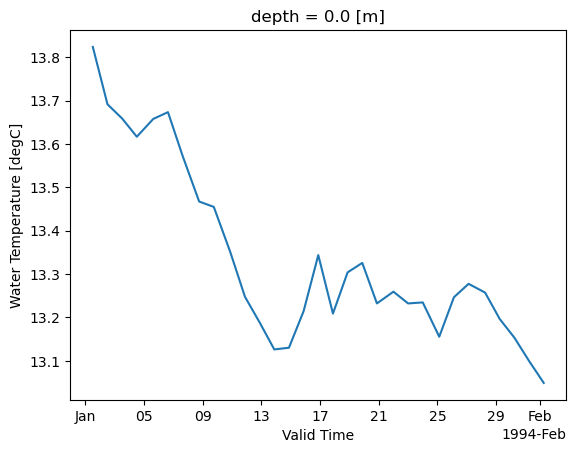
Because the lat/lon is not chunked, we have to read a full slice (117Mb) for each time step. So this is slow and parallelization is limited. But it works.
# slice the time to be once a day, to speed things up
ts = (
    ds["water_temp"]
    .sel(
        depth=0,
        time=slice("1994-01-01", "1994-02-01"),
        lat=slice(40, 50),
        lon=slice(-45, -35),
    )
    .isel(time=slice(None, None, 8))
    .mean(["lat", "lon"])
    .compute()
)

ts.plot()